The CSL Blog Inheritance Disputes
California Trustee Fiduciary Duties & Beneficiary Rights
Trustee won't share information or provide an accounting? Learn California trustee fiduciary duties, beneficiary rights, and steps to enforce them.
California Trustee Fiduciary Duties: What Trustees Owe Beneficiaries (and What to Do When Things Go Sideways)
If you’re a trust beneficiary in California and you feel like the trustee is keeping you in the dark, you’re not imagining things. Most trust disputes start the same way: one person controls the checkbook and the information, communication becomes “whenever I get to it,” and everyone else is told to “be patient.”
But California law doesn’t give trustees a “just trust me” option.
A trustee is a fiduciary. That isn’t just a professional title; it’s a rigorous legal job description that carries the highest standard of care known to the American legal system. When a trustee accepts the role, they take on real obligations, real exposure, and (when things go sideways) real consequences.
Below is a practical guide to the fiduciary duties a California trustee owes beneficiaries, updated with 2026 legislative changes, and examples of the red flags we see in actual litigation.
What “Fiduciary Duty” Actually Means in 2026
In California trust administration, a fiduciary is required to act with reasonable care, skill, and caution. The question isn’t whether the trustee “meant well.” It is whether the trustee followed the trust terms, followed the law, and managed assets in the beneficiaries’ best interests.
Notably, if a trustee represents themselves as having special skills (like an attorney, CPA, or professional advisor), California courts will hold them to that higher expert standard rather than the standard of an ordinary person.
The Revocable Trust Exception
While a trust is still revocable and the settlor (the person who created it) is alive and competent, the trustee’s duties are generally owed to the settlor, not the future beneficiaries. Your rights as a beneficiary typically become fully enforceable once the trust becomes irrevocable, usually upon the settlor’s death.
The 12 Core Fiduciary Duties Every California Trustee Must Honor
These duties are codified in the California Probate Code (Sections 16000–16014). If you see a trustee ignoring these rules, it is a sign that your inheritance may be at risk.
- Follow Trust Terms (§ 16000): the primary duty to follow the trust instrument and applicable law.
- Loyalty (§ 16002): must act exclusively for the benefit of the trust beneficiaries.
- Impartiality (§ 16003): cannot favor one beneficiary over another unless the trust explicitly says so.
- Avoid Conflicts (§ 16004): prohibition against self-dealing or transactions that benefit the trustee.
- No Forced Waivers (§ 16004.5): trustee cannot demand a liability waiver as a condition for a mandatory distribution.
- Preserve Property (§ 16006): duty to gather, secure, and protect all trust assets (e.g., insurance, locks).
- Standard of Care (§ 16040): must act with reasonable care, skill, and caution (the “Prudent Person” rule).
- Investment Duty (§ 16045+): must manage investments prudently and diversify assets to manage risk.
- No Delegation (§ 16012): cannot dump the job on others for acts the trustee should perform personally.
- Co-Trustee Duty (§ 16013): each co-trustee must participate and stop the other from committing a breach.
- Inform & Report (§ 16060): must keep beneficiaries reasonably informed about the trust administration.
- Accountings (§ 16062): must provide formal financial reports at least annually and at trust termination.
2026 Legislative Updates: What Beneficiaries Need to Know
California trust law is constantly evolving. In 2025 and 2026, several new laws changed the playing field for trustees and heirs:
- AB 2016 (Small Estate Thresholds): effective April 1, 2025, the threshold to bypass full probate for personal property increased to $208,850. More importantly, heirs can now use a simplified Succession to Real Property petition for primary residences valued at $750,000 or less.
- AB 1521 (Notice Requirements): for estates where Letters are issued on or after January 1, 2026, the personal representative has an expanded duty to notify the Director of Child Support Services if the decedent may have owed unpaid support.
- Digital Assets (DFAL): by July 1, 2026, trustees managing significant digital or crypto-assets must ensure they use platforms properly licensed under California’s Digital Financial Assets Law.
- SB 280 (Care Plans): if a trust administration involves a conservatorship, the conservator must now file a mandatory Care Plan within 120 days of appointment, a document that can provide critical evidence of a trustee’s unfitness if they fail to follow it.
When Things Go Sideways: Trustee Removal and Surcharges
If a trustee breaches their fiduciary duty, they don’t just lose the job. They may have to pay for it out of their own pocket.
Removal under Section 15642
A court can remove a trustee for:
- Breach of trust: mismanagement, self-dealing, or playing favorites.
- Insolvency or unfitness: inability to manage money or the complexity of the trust.
- Hostility: conflict between co-trustees or with beneficiaries that impairs the trust.
- Excessive compensation: charging fees that aren’t reasonable for the work performed.
Personal Liability (the Surcharge)
Under Probate Code § 16440, a trustee who breaches their duty is liable for the greater of:
- Any loss or depreciation in value of the trust estate resulting from the breach.
- Any profit made by the trustee through the breach.
- Any profit that would have accrued to the trust if the breach hadn’t occurred.
Interest: surcharges typically include interest at the legal rate on judgments. While the standard rate is 10%, recent 2023 changes can lower the rate to 5% for natural persons in specific circumstances.
Protecting Your Inheritance: When to Seek Legal Advice
Beneficiaries often hesitate to contact an attorney because they fear high costs or family conflict. However, in the 2026 legal landscape, where property values are high and asset types (like digital holdings) are complex, waiting too long to enforce your rights can result in the permanent loss of trust value.
Recognizing the Tipping Point
You should consider a professional legal review if you experience any of the following:
- The 60-day silence: you have made a formal written request for an accounting or information and have received no response within 60 days.
- Suspicious real estate activity: the trustee is selling trust property below market value or to a related party without an open-market process.
- Asset drift: large sums of cash are sitting in non-interest-bearing accounts, or the trustee cannot provide an inventory of the decedent’s personal property.
- Forced waivers: the trustee tells you that you will only receive your distribution if you sign a document releasing them from all liability for their past actions.
The Value of a Preliminary Assessment
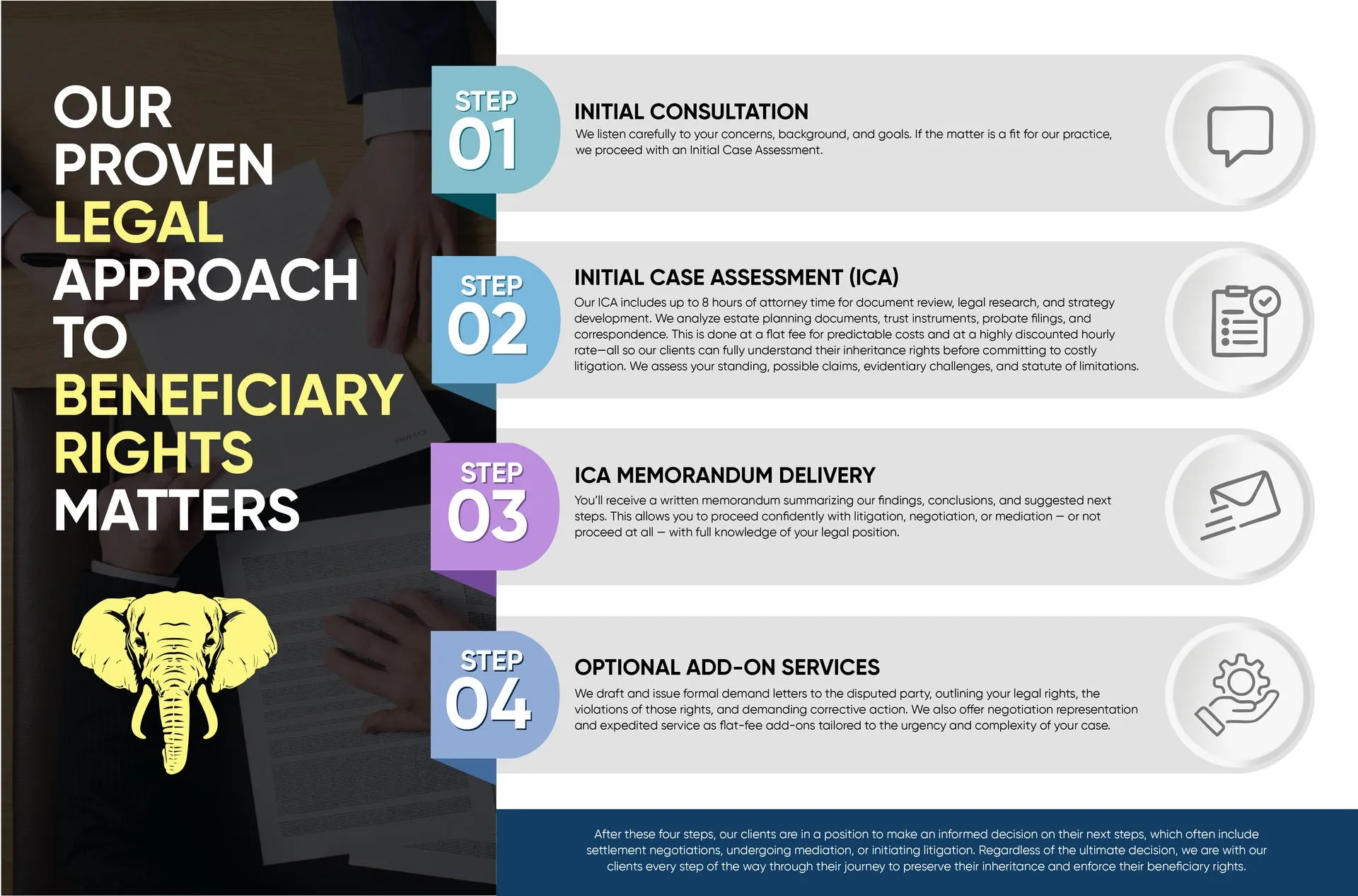
Modern, value-driven legal services now offer streamlined ways to evaluate your situation without committing to open-ended litigation fees. A preliminary review, such as an Initial Case Assessment (ICA), typically provides:
- Transparency audit: a professional comparison of what the trustee has disclosed against what the California Probate Code actually requires.
- Risk modeling: a data-driven look at whether the trustee’s actions meet the legal threshold for removal or a financial surcharge.
- Strategy roadmap: guidance on whether your goals are best achieved through a simple demand letter, professional mediation, or a formal court petition.
By acting early, you can often resolve disputes before they escalate into multi-year court battles. If you are seeing these red flags, a confidential consultation can help you decide whether your next step should be a quiet negotiation or a strategic legal intervention.
FAQ: Beneficiary Rights in 2026
Do I have a right to see the trust?
Yes. Once a trust becomes irrevocable, beneficiaries have a statutory right to a complete copy of the trust terms, including all amendments.
How long does a trustee have to provide an accounting?
If you make a formal written demand, the trustee generally has 60 days to provide the accounting. If they refuse, you can petition the court to compel the report and potentially order the trustee to pay your legal fees.
Can a trustee stop me from suing by withholding my distribution?
Generally, no. Under Probate Code § 16004.5, a trustee cannot require you to sign a liability waiver or release as a condition for making a distribution that is already required by the trust terms.
What if the trustee is also a beneficiary?
They are still held to the same strict fiduciary duties. In fact, courts often look more closely at beneficiary-trustees to ensure they aren’t using their position to favor their own share of the inheritance.
This article is general information, not legal advice for your specific situation. Reading it does not create an attorney-client relationship.